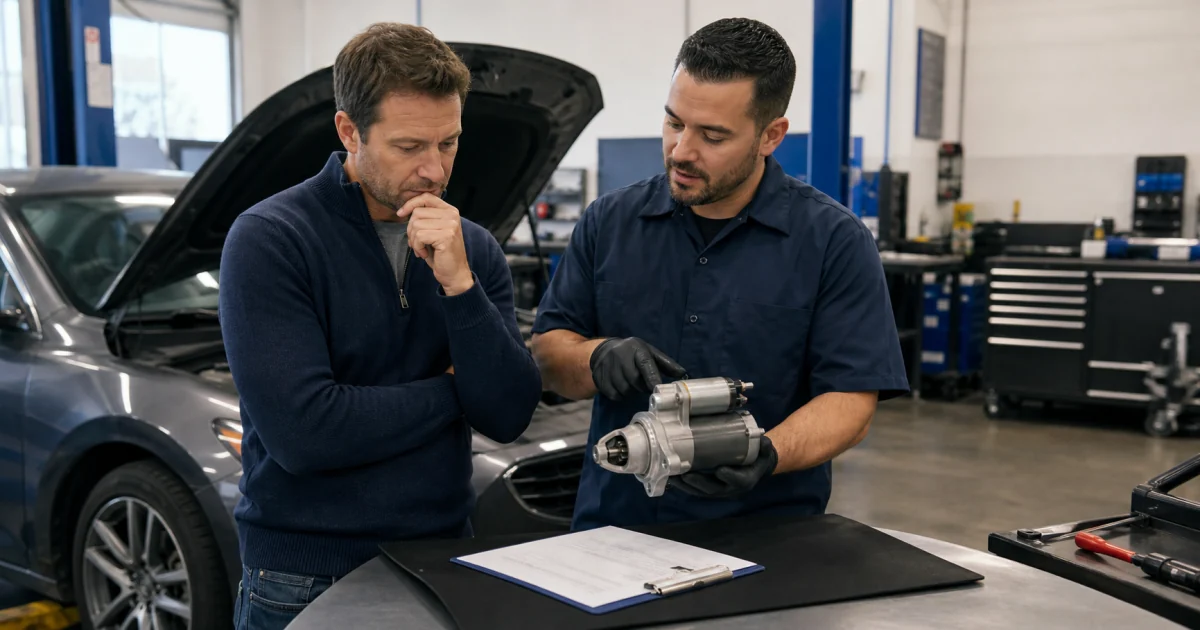
You turn the key or press the start button and hear a click, slow cranking, or nothing at all. The immediate question is often, “Is the starter covered?” The useful first question is different: “What actually failed?” A starter motor is only one part of the starting circuit, and the answer can send the same repair to four different payers—or leave it as an owner expense.
This guide applies mainly to gasoline and diesel vehicles with a conventional starter. Some hybrids use an integrated starter-generator or another starting design, and battery-electric vehicles do not use a conventional engine starter. For those vehicles, use the model-specific warranty, service information, and contract language.
The four coverage paths
| Possible payer | What must line up | What to verify before repair |
|---|
| Manufacturer warranty | The warranty is still active, the starter or starting system falls within its covered section, and the failure meets its terms. | In-service date, mileage, warranty section, exclusions, and whether diagnosis must occur at an authorized dealer. |
| Safety recall or manufacturer campaign | The VIN is included and the diagnosed condition matches the campaign. | Official VIN lookup, safety instructions, remedy availability, and the authorized dealer performing the remedy. |
| Vehicle service contract | The starter is listed in a stated-component plan or is not excluded from an applicable exclusionary plan, and the failure and claim process qualify. | Covered-part wording, cause-of-failure rules, exclusions, deductible, labor and parts limits, repair-facility rules, and prior authorization. |
| Replacement-part or repair warranty | The starter was replaced before and the applicable part or shop warranty is still active. | Prior invoice, part number, time and mileage limits, labor coverage, and the required return location. |
The labels matter. The Federal Trade Commission explains that a manufacturer warranty comes with the vehicle, while an optional auto service contract—often marketed as an “extended warranty”—is a separate contract that pays only for repairs or services described in its terms. The Consumer Financial Protection Bureau makes the same distinction. DriveOn is a vehicle service contract, not a manufacturer warranty.
Why “powertrain warranty” is not enough
The starter helps the engine begin running, but that does not make it an internal engine part. Some factory basic warranties cover most components for a shorter period, while longer powertrain warranties name specific engine, transmission, and drive-system parts. For example, Toyota’s current warranty overview describes broad basic coverage separately from listed powertrain systems. That example is not a rule for every Toyota or every automaker; it shows why an owner should use the exact warranty guide for the VIN and model year rather than rely on the word “powertrain.”
A service contract has a similar reading problem. In a stated-component contract, look for terms such as starter motor, starter solenoid, starter drive, electrical system, or hybrid starter-generator. If the component is not listed, it may not be covered. In an exclusionary contract, start with the exclusions, then read definitions and related-damage rules. Coverage of the starter does not necessarily cover a battery, cable, relay, wiring repair, damaged flywheel teeth, diagnostic charge, towing, or every labor dollar.
A no-start condition is not yet a starter diagnosis
A proper diagnosis separates the symptom from the root cause. Ask the shop to document battery state and load-test results, cable and ground condition, voltage-drop findings where appropriate, relay or fuse checks, relevant trouble codes, starter current or bench-test findings, and whether the engine can rotate. The exact test path depends on the vehicle; hybrid and start-stop systems can require model-specific procedures and high-voltage precautions.
Do not bypass safety systems, strike a starter, crawl under an unsupported vehicle, or probe a high-voltage system to create evidence for a claim. A qualified repair facility can document the cause. The FTC’s auto-repair guidance recommends a written estimate that identifies the condition, required parts, and anticipated labor, plus approval before work exceeds an agreed limit.
Check recalls before treating it as a contract claim
A current example shows why the VIN check belongs near the top. In NHTSA recall 26V441, BMW reported that certain 2016–2020 plug-in hybrid vehicles may have starter-relay corrosion that can affect starting and, in some cases, create a short circuit and overheating risk. The official July 2026 safety recall report identifies 29,119 potentially involved vehicles, specifies starter replacement as the remedy, and says owners should park outside and away from structures until the recall repair is complete.
That warning applies to affected vehicles—not to every car with a failed starter. The report schedules owner notification and VIN searchability for August 28, 2026, eight days after this guide’s publication. Potentially affected owners should use NHTSA’s official recall lookup, check again when VIN data is scheduled to be available, and follow BMW’s official instructions. Recall repairs are handled through the manufacturer’s authorized dealer and are separate from a service-contract claim. Our recall, TSB, and warranty guide explains the boundaries.
Separate the failed starter from the cause
Even when “starter motor” appears in a coverage list, the reason it failed can change the decision. A covered internal electrical or mechanical breakdown is different from collision damage, flooding, rodent damage, corrosion where excluded, an unauthorized modification, improper installation, a pre-existing condition, or damage caused by another non-covered part. A discharged or worn-out 12-volt battery may also be treated differently from the starter it could not energize.
Do not assume that one excluded item erases unrelated coverage. Ask for the administrator’s failure sequence in writing: which part failed first, what evidence supports that conclusion, and which contract clause applies. If the condition existed before coverage began, review our pre-existing-condition guide. If an accessory or replacement part is blamed, our aftermarket-parts guide explains how causation matters.
Your 8-step starter coverage checklist
- Record the VIN, mileage, warning messages, sounds, when the symptom began, and whether the engine cranks, clicks, or stays silent.
- Check the VIN for an open recall, manufacturer campaign, remaining factory coverage, and any certified-used warranty.
- Find prior starter or electrical-repair invoices and read their part and labor warranty terms.
- Get a written diagnosis naming the failed part and root cause, supported by appropriate battery, circuit, code, and starter testing.
- Read the service contract’s covered components, exclusions, definitions, related-damage rules, deductible, limits, and maintenance provisions.
- Have the repair facility contact the administrator and obtain any required authorization before replacement or disassembly.
- Ask the estimate to separate diagnosis, starter, related electrical work, labor, towing, taxes, and any owner-pay items.
- Keep the test results, estimate, authorization or written denial, final invoice, replaced-part information, and new repair warranty.
How DriveOn fits
DriveOn is designed to help with eligible mechanical and electrical breakdowns under the selected vehicle service contract. Whether a starter-related repair qualifies depends on the actual contract, covered component, exclusion, vehicle eligibility, failure cause, pre-existing-condition rules, maintenance obligations where relevant, limits, deductible, prior authorization, and claim circumstances. No starter replacement is automatically promised.
A licensed U.S. repair facility can diagnose the no-start condition and contact the claims line before work begins. Review the DriveOn claims process, the coverage boundaries, and your actual contract. If you are comparing protection before a breakdown, you can check vehicle eligibility without treating a generic component list as a guarantee.
Bottom line
A starter may be covered, but “the car will not start” is not enough to identify the payer. Confirm the diagnosis, check the VIN, locate the right warranty or contract, and get the required approval before replacement. The most useful question for the shop or administrator is: “Which part failed, what caused it, and which written term makes this repair covered—or not covered?”