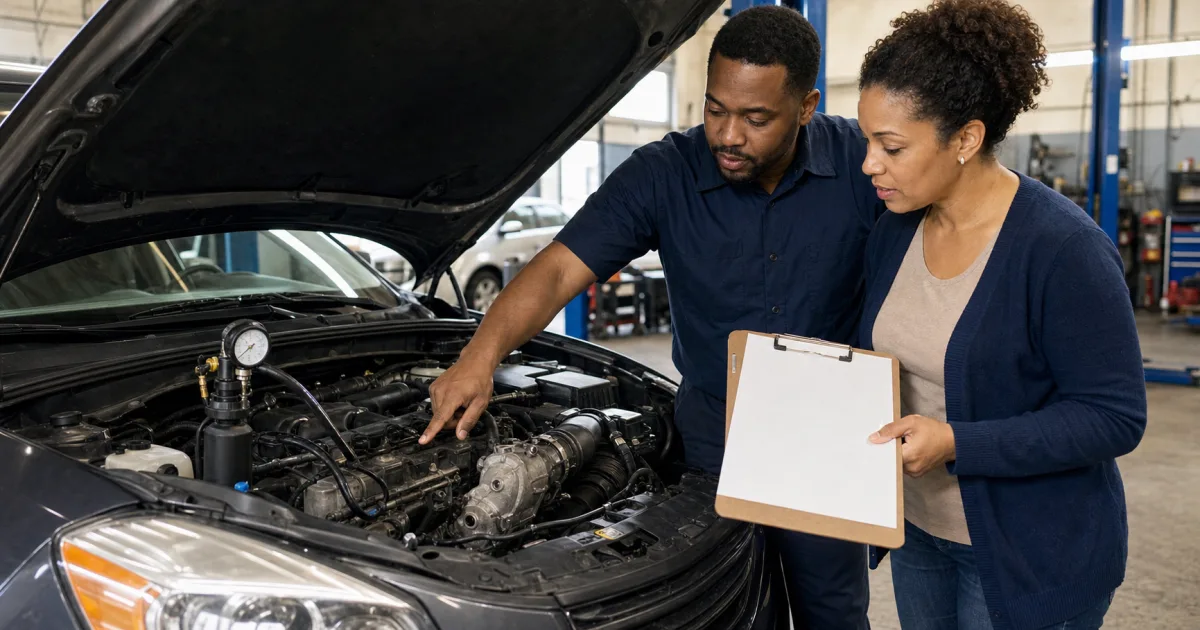
Water-pump questions usually begin with a symptom: a temperature warning, steam, low coolant, a puddle, a grinding noise, or heat that stops working normally. None of those proves that the pump failed. A hose, radiator, thermostat, reservoir, cooling fan, belt, electrical connector, head gasket, or another leak can create overlapping symptoms.
So the useful question is not simply “Is the water pump under warranty?” Ask: “Which component failed, what caused the failure, and which active agreement or legal warranty applies?” The FTC explains that a manufacturer warranty comes with the vehicle, while an optional auto service contract—often marketed as an “extended warranty”—is a separate product governed by its own written terms.
The five-step water-pump coverage check
| Step | Question to answer | Best evidence |
|---|
| 1. Diagnose | Did the pump fail, or is another cooling-system part causing the symptom? | Pressure test, leak location, scan data, electrical tests, and technician notes. |
| 2. Identify the pump | Is it a belt-driven mechanical pump, electric main pump, auxiliary pump, or related connector/module? | VIN-specific part number and itemized estimate. |
| 3. Check every payer | Is a factory warranty, recall, service contract, state warranty, or prior repair warranty active? | In-service date, mileage, VIN lookup, contracts, and invoices. |
| 4. Establish first cause | Was the failure a covered breakdown, defect, recalled condition, or damage from an excluded cause? | Photos, test results, coolant condition, maintenance records, and written findings. |
| 5. Authorize | Must the repair facility obtain approval before replacement or teardown? | Claim instructions and written authorization. |
1. Confirm the water pump is actually the failed part
A cooling-system pressure test may locate an external leak. A technician may also inspect the pump’s weep area, shaft or bearing, belt drive, electrical supply, coolant flow, stored diagnostic codes, commanded versus actual pump operation, and signs of leakage elsewhere. The appropriate tests depend on the vehicle; many newer engines use electric or variable-output pumps, and some vehicles have more than one coolant pump.
Ask the shop to state the failed component and its first cause in writing. “Cooling system leak” is too broad. “Main electric coolant pump does not run with verified power and ground” or “mechanical pump leaks at the shaft seal” is much more useful. If overheating may have damaged the engine, request separate findings for the pump and any consequential damage. That separation matters because one item may qualify while another does not; our engine-replacement coverage guide explains the same first-cause problem at a larger scale.
2. Match the exact pump to the exact document
Do not assume every manufacturer classifies a water pump the same way. Depending on the make, model year, engine, and warranty booklet, a particular pump may be listed under powertrain, basic, hybrid/EV, emissions, or another section—or may not remain covered at the vehicle’s current age and mileage. Certified-used warranties can have their own parts lists and time limits.
The Consumer Financial Protection Bureau distinguishes a manufacturer warranty, generally included with a new vehicle, from optional service contracts and extended-warranty products whose coverage varies. For a service contract, search the actual agreement for “water pump,” “cooling system,” “electric coolant pump,” and related electrical parts. Then read definitions, exclusions, maintenance obligations, limits, deductible rules, and claim procedures. A salesperson’s summary is not a substitute for the contract.
3. Check all five possible payer paths
| Possible payer | When it may apply | What can change the answer |
|---|
| Manufacturer warranty | The relevant warranty is active and covers the diagnosed part and failure. | In-service date, mileage, component category, defect terms, and exclusions. |
| Safety recall or campaign | The VIN is included and the remedy addresses the condition. | VIN eligibility, campaign status, and prescribed remedy. |
| Vehicle service contract | The selected contract covers the exact pump and the claim meets its terms. | First cause, eligibility, exclusions, limits, deductible, maintenance, and authorization. |
| State-required dealer warranty | A qualifying used-car purchase is protected by a specific state law. | State, seller, purchase date, mileage, vehicle use, notice, and statutory exceptions. |
| Earlier parts or repair warranty | A previously replaced pump or related repair remains within its written warranty. | Invoice, part and labor terms, time/mileage limit, and return-facility rules. |
Start with NHTSA’s official VIN recall lookup and the manufacturer’s owner portal. Recall coverage is not the same as warranty or service-contract coverage. For example, BMW recall 24V-608 concerns the electrical plug connector for the water pump on specified vehicles. Its official owner notice describes an inspection, possible pump and connector replacement, and a shield—free for affected VINs. That does not make every BMW water-pump repair recalled or every pump failure free.
State law can add another path, but it is not nationwide. New York’s used-car lemon-law fact sheet, for example, lists the water pump among covered engine parts for qualifying dealer-sold vehicles within specific purchase, mileage, use, and notice conditions. Drivers elsewhere should check their own attorney general or motor-vehicle agency rather than applying New York’s rule to another state.
4. Document the first cause and maintenance
The pump name alone does not settle a claim. A contract or warranty may treat a pump defect differently from damage linked to contaminated or incorrect coolant, freezing, collision or road debris, overheating after a warning, modification, improper prior repair, or failure of an excluded part. Those are possible issues, not automatic reasons to deny coverage.
Keep maintenance receipts and the owner-manual schedule, especially records for coolant inspection or replacement where required. The FTC notes that warranty or service-contract providers may ask for maintenance records, but outside maintenance does not by itself cancel a manufacturer warranty. If a claim is declined, ask for the decision in writing, the precise clause, and the evidence connecting that clause to the failure. Use our claim-denial documentation checklist before assuming the first answer is final.
5. Separate the estimate and get authorization
Ask for an itemized estimate showing diagnosis, pump, coolant, seals, belt or hardware, related electrical work, programming or bleeding procedures, labor, taxes, shop supplies, towing, and any owner-pay work. Consequential engine damage should be listed separately. The FTC’s auto-repair guidance recommends a written estimate that identifies the condition, needed parts, and anticipated labor, plus approval before exceeding the agreed amount.
If a service contract may apply, have the licensed repair facility contact the administrator before replacing the pump, disassembling the cooling system, or beginning related engine work. The administrator may require test results, maintenance records, photographs, an inspection, or another estimate. Clarify who pays diagnosis or teardown if the failure is not covered; our diagnostic and teardown fee guide helps you ask that question before work starts.
Your water-pump claim checklist
- Record the VIN, mileage, warning messages, symptoms, coolant observations, and when the problem began.
- Follow the owner manual’s overheating instructions and arrange a tow when the vehicle cannot be driven safely.
- Get the exact pump or related component, test evidence, and first cause in writing.
- Check the model-year factory, certified-used, hybrid/EV, and emissions warranty documents that apply.
- Search the VIN for open recalls and manufacturer campaigns.
- Read the service contract’s covered-parts or exclusionary language, definitions, limits, deductible, and authorization rules.
- Check state used-car warranty rights and any earlier repair warranty.
- Gather maintenance receipts, photos, scan data, pressure-test findings, and the itemized estimate.
- Obtain required authorization before replacement, teardown, or related engine work.
How DriveOn fits
DriveOn is a vehicle service contract, not a manufacturer warranty. It is designed to help with eligible mechanical and electrical breakdowns under the selected contract. Whether a water-pump or cooling-system repair qualifies depends on the actual contract terms, covered component, exclusions, vehicle eligibility, failure cause, pre-existing-condition rules, maintenance obligations where relevant, limits, deductible, authorization, and claim circumstances. No cooling-system repair is automatically promised.
An eligible licensed U.S. repair facility can diagnose the concern and contact the claims line before work begins. Review the DriveOn claims process, the coverage boundaries, and your own contract. If you are considering protection before symptoms appear, you can check vehicle eligibility without treating a generic component example as a coverage guarantee.
Bottom line
A water pump may be covered, but a hot engine is not a component-level diagnosis and “powertrain” is not a complete answer. Identify the failed pump or related part, establish the first cause, check each active payer path, and get required authorization before repair. The sentence to bring to the shop is: “Please show me which cooling-system part failed, what the tests prove, and which written coverage term applies.”