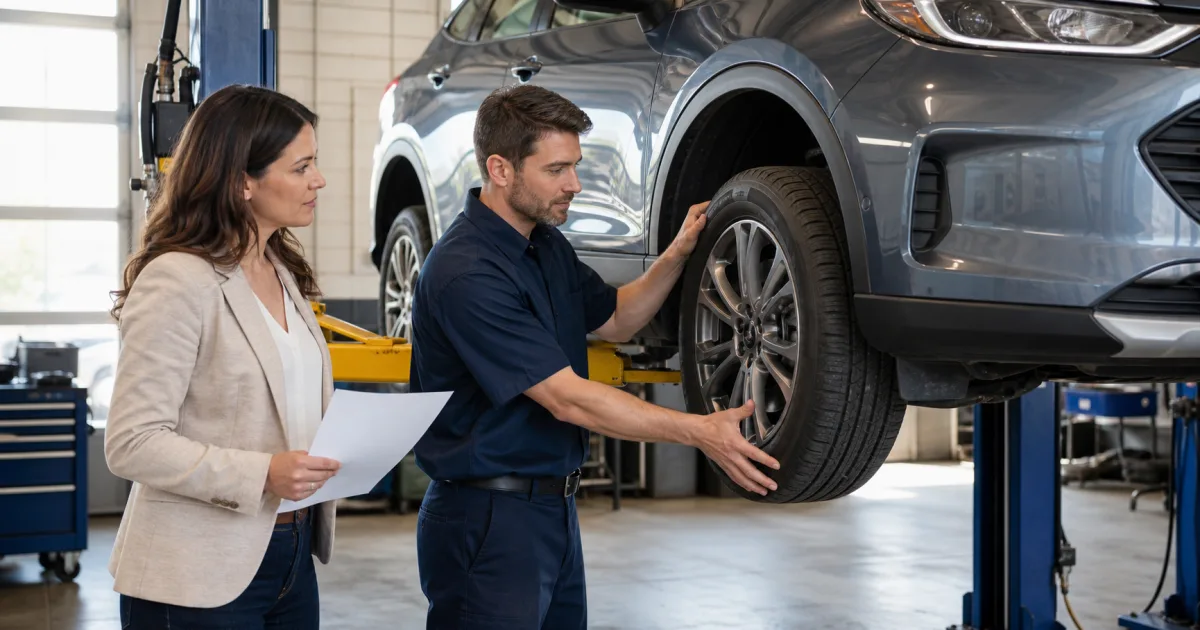
A wheel bearing lets the wheel rotate with low friction while supporting the vehicle’s load. On many modern cars it is supplied as part of a sealed hub assembly; on others, the bearing and hub can be serviced separately. That vocabulary matters because a contract may say “wheel bearings,” “hub bearings,” or “hub assemblies”—and those terms do not always produce the same claim answer.
The better first question is not simply “Are wheel bearings covered?” It is: “Which part failed, why did it fail, and which active agreement applies?” Use the following framework before approving a repair.
Four possible paths that may pay
| Possible payer | When it may apply | What to verify |
|---|
| Manufacturer basic warranty | The warranty is still active and the failure meets its defect and use terms. | In-service date, mileage, covered section, exclusions, and dealer diagnosis. |
| Vehicle service contract | The bearing or hub is listed, or not excluded under applicable exclusionary coverage, and the breakdown qualifies. | Exact component wording, cause rules, deductible, limits, maintenance duties, and prior authorization. |
| Recall or manufacturer campaign | The VIN is included and the diagnosed condition matches the official remedy. | Official VIN lookup, campaign status, safety instructions, and authorized dealer remedy. |
| Prior part or repair warranty | The bearing or hub was replaced before and that repair warranty remains active. | Invoice, part number, time/mileage limit, labor terms, and required return location. |
These labels are different. The Federal Trade Commission explains that an auto service contract is optional protection purchased separately from the warranty that comes with a vehicle. The Consumer Financial Protection Bureau makes the same distinction: a manufacturer warranty is included with the vehicle, while an “extended warranty” is usually a vehicle service contract.
1. Confirm the noise really comes from a bearing
A worn wheel bearing can create a humming, growling, or rumbling sound that changes with road speed or vehicle load. But uneven tire wear, cupped tread, a dragging brake, CV-joint trouble, differential noise, or another suspension or steering problem can sound similar. An ABS or stability-control light can appear when a hub’s integrated wheel-speed sensor or tone ring is involved, but the warning light alone does not identify the failed part.
Ask the technician to record which corner is affected and the evidence: road-test observations, play or roughness at the wheel, chassis-ear results if used, scan codes, sensor data, tire findings, brake drag, and any damage discovered after disassembly. Avoid treating a phone recording or a quick parking-lot guess as the final diagnosis.
2. Identify the exact part on the estimate
Have the estimate separate “bearing,” “hub,” “hub assembly,” “wheel-speed sensor,” axle hardware, steering knuckle work, brake work, alignment, and diagnostic labor. This prevents a covered bearing from being confused with an excluded tire, routine brake item, or unrelated sensor—and it shows which operations are truly necessary.
Model-specific documents demonstrate why precision matters. A 2026 BMW service bulletin filed with NHTSA addresses certain rear-wheel-bearing complaints, requires diagnosis and fault-code verification, and describes coverage under specific new-vehicle or certified-used terms. It is not a promise for every BMW or any other vehicle; it is a useful example of diagnosis-, vehicle-, and program-specific coverage.
3. Find the first cause, not just the damaged part
Coverage can change when impact, collision damage, water intrusion, improper installation, modification, neglected related repairs, a loose fastener, or another excluded condition caused the loss. A contract may cover a mechanical breakdown but exclude outside damage or consequential damage from a noncovered cause. A pothole or curb strike may also raise a separate auto-insurance question rather than a warranty claim.
Ask the shop to state the most likely first cause and its evidence. If a claim is denied because another condition allegedly caused the bearing failure, request the written explanation, the specific contract clause, and the diagnostic basis. That same documentation discipline matters for reviewing a repair-claim denial or a disputed pre-existing condition.
4. Check the VIN, warranty dates, contract, and old invoice
Enter the VIN—not just the year, make, and model—in NHTSA’s official recall lookup, then check the manufacturer owner portal. A recall is VIN-specific and its remedy is handled separately from a service-contract claim. A technical service bulletin, by contrast, is repair information; it does not automatically make work free. See our recall, TSB, and warranty guide for the practical differences.
Recent records also show why owners should not generalize from a headline. NHTSA recall 26V304 covers a limited set of vehicles with particular 24-inch wheels and specified dealer-installed or service histories; the official Part 573 report describes that narrow population. It does not mean every hub or wheel-bearing concern on those models is recalled.
Next, compare the vehicle’s original in-service date and current mileage with the manufacturer warranty booklet. Search the service contract for bearing, hub, suspension, steering, axle, ABS, sensors, seals, fasteners, exclusions, and definitions of breakdown. Finally, look for an earlier bearing invoice: a parts or shop warranty may be the correct path even when factory coverage has ended.
5. Obtain authorization before parts come off
A vehicle service contract may require the repair facility to contact the administrator before disassembly or replacement. The administrator may request test results, photographs, maintenance or prior-repair records, an inspection, or another estimate. Starting the work first can interfere with that process or violate the authorization terms.
Ask for a written estimate that separates diagnosis, parts, labor, taxes, alignment, related brake or sensor work, the deductible, and any owner-pay difference. The FTC’s auto-repair guidance recommends a written estimate identifying the condition, parts, and anticipated labor, along with approval before work exceeds an agreed amount. If teardown is proposed, clarify who pays if the claim is not covered; our diagnostic and teardown fee guide provides a focused checklist.
Your wheel-bearing coverage checklist
- Record the VIN, mileage, noise, warning lights, affected corner, and when the symptom began.
- Ask whether continued driving is safe; arrange a tow if the vehicle feels unstable or the shop advises it.
- Get the diagnosis and first-cause evidence in writing, not only “needs a hub.”
- Separate the bearing, hub, sensor, brake, tire, alignment, and hardware items on the estimate.
- Check the manufacturer warranty, certified-used coverage, VIN-specific recalls, service contract, and prior-repair warranty.
- Locate the exact covered-component or exclusion language and confirm time, mileage, deductible, and limits.
- Have the repair facility obtain required authorization before removal or replacement.
- Keep the test results, estimate, authorization or written denial, final invoice, and new repair warranty.
How DriveOn fits
DriveOn is a vehicle service contract, not a manufacturer warranty. It is designed to help with eligible mechanical and electrical breakdowns under the selected contract. Whether a wheel-bearing or hub-related repair qualifies depends on the actual contract terms, covered component, exclusions, vehicle eligibility, failure cause, pre-existing-condition rules, maintenance obligations where relevant, limits, deductible, authorization, and claim circumstances. No bearing or hub repair is automatically promised.
An eligible licensed U.S. repair facility can diagnose the concern and contact the claims line before work begins. Review the DriveOn claims process, the coverage boundaries, and your actual contract. If you are comparing protection before a breakdown, you can check vehicle eligibility without treating a generic component list as a guarantee.
Bottom line
A wheel bearing may be covered, but a growl or vibration does not settle the diagnosis or the payer. Confirm the affected part, document the first cause, check every active coverage path, and obtain authorization before the hub comes apart. The most useful sentence to bring to the shop is: “Please show me which part failed, what proves it, and which written term applies.”