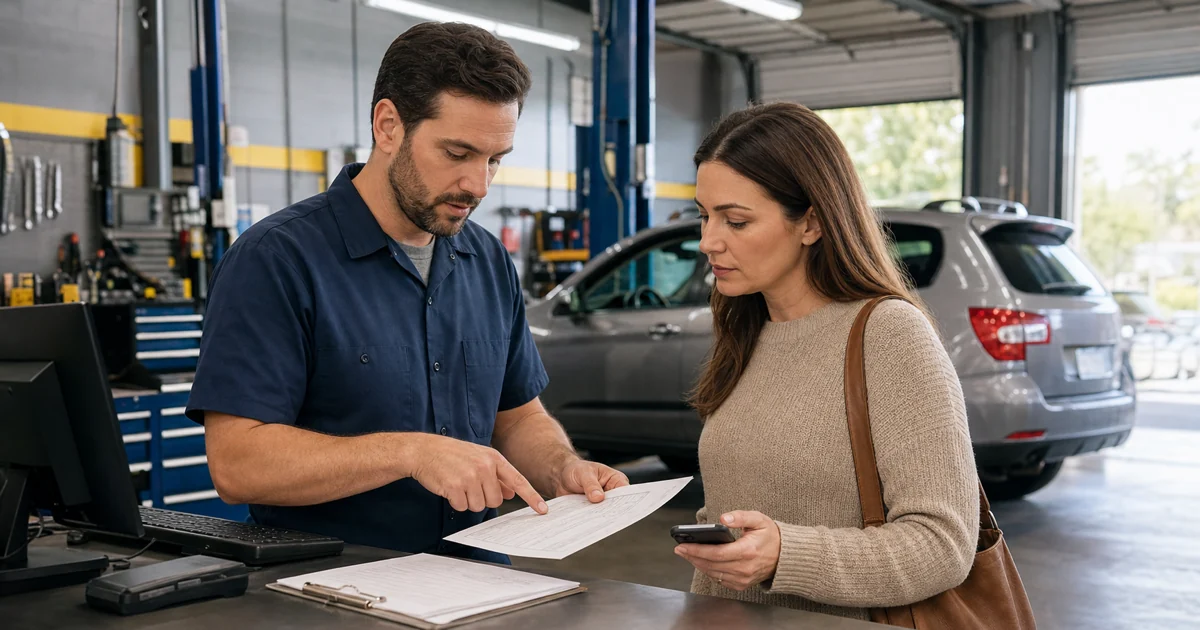
A service advisor may use the word "estimate," a technician may describe a likely failure, and a contract administrator may issue an authorization number. Those are related, but they are not interchangeable. The estimate describes proposed work and price. The diagnosis explains what the shop believes failed and why. Authorization records permission to proceed. A coverage decision states what a particular warranty or contract will pay under its rules.
The Federal Trade Commission's auto-repair guidance recommends getting a written estimate that identifies the condition, needed parts, and anticipated labor, and says it should explain when the shop must contact you before exceeding an agreed amount. State rules differ, so use this guide as a practical conversation framework rather than legal advice.
1. Describe the symptom before accepting the repair
Start with what the vehicle actually did: when the warning appeared, whether the engine was cold or hot, the speed and road conditions, sounds or smells, recent work, and whether the symptom is constant or intermittent. A precise complaint gives the technician a better starting point and creates a record that can be compared with the final diagnosis.
Then ask what test confirmed the failure. A trouble code, fluid stain, noise, or worn part may be evidence, but it may not identify the first cause. Request the relevant codes, measurements, inspection photos, or test result in plain language. The useful question is not merely "What part are you replacing?" but "What evidence shows this part failed, and what caused it to fail?"
2. Separate diagnosis from permission to repair
Authorizing diagnostic time is not necessarily the same as authorizing the complete repair. Put a dollar or labor-hour ceiling on the initial diagnosis, and ask the shop to stop and contact you before teardown, additional testing, parts ordering, or repair work exceeds that boundary. If teardown may be required, ask what reassembly would cost if you decline the repair or if the failed part is not covered.
California's Bureau of Automotive Repair explains, in its updated documentation and authorization guide, that authorization can be written, oral, or electronic under California rules and must be documented before work begins. Your state's details may differ, but the operational lesson travels well: make the scope, time, contact method, and approved amount unmistakable.
3. Identify every possible payer
Check the vehicle's in-service date, mileage, warranty booklet, prior repair invoices, and VIN before assuming the owner must pay. Possible paths include the original manufacturer's warranty, a manufacturer-backed extended warranty, a safety recall, a VIN-specific warranty extension or service campaign, a parts-and-labor warranty from an earlier repair, insurance for a covered external event, or a separately purchased vehicle service contract.
The Consumer Financial Protection Bureau distinguishes a manufacturer's warranty included with a new vehicle from an optional service contract sometimes marketed as an extended warranty. Also check the VIN with the National Highway Traffic Safety Administration recall lookup. A recall remedy is different from a service-contract claim, and an open recall does not prove that every related symptom or resulting repair is included.
4. Get the proposed repair itemized
Ask for separate lines for diagnostic labor, teardown, each part, shop supplies, fluids, programming or calibration, taxes, towing, storage, and any recommended maintenance. The estimate should also identify whether parts are new original-equipment, new aftermarket, remanufactured, rebuilt, or used, plus the repair facility's warranty on parts and labor.
Itemization makes two common gaps visible. First, a payer may authorize the failed covered part but not unrelated maintenance or excluded components. Second, the shop's labor rate, labor time, part choice, or markup may exceed what the payer authorizes. Neither gap should first appear when the car is ready for pickup.
- Ask which line fixes the confirmed failure and which lines are preventive or optional.
- Ask whether taxes, fluids, fasteners, programming, and diagnostic time are included in the quoted total.
- Ask what could change after teardown and who must approve that change.
5. Confirm coverage before work begins
If a vehicle service contract may apply, follow its claim procedure before authorizing repair. The FTC's service-contract guidance specifically advises consumers to ask about pre-approval, diagnostic teardown, labor limits, replacement-part rules, towing, rental benefits, maintenance requirements, and who is allowed to perform repairs.
Have the repair facility contact the administrator, then record the claim number, authorization number, approved components, approved labor, deductible, and any amount that remains uncertain. An authorization can still be subject to contract limits, continued diagnosis, inspection, documentation, exclusions, eligibility, maintenance obligations, and the actual circumstances of the breakdown. Never treat a phone estimate from the shop as the administrator's final written decision.
6. Calculate the owner-pay number
Ask for one simple reconciliation: total proposed repair, less the amount each payer has authorized, equals the amount you are expected to pay. The owner-pay side may include a deductible, non-covered diagnosis, excluded or maintenance items, labor-rate or labor-time differences, upgraded parts, taxes, or costs above a contract limit. Ask which amounts are fixed and which could still change.
Do not confuse "the part is covered" with "the entire invoice is paid." Conversely, do not assume a partial authorization is wrong until the shop and administrator compare the same estimate line by line. If the explanation is unclear, request the relevant contract provision and the written estimate rather than relying on shorthand.
7. Know when to pause for a second opinion
A second opinion is worth considering when the proposed repair is large, the diagnosis is not supported by a clear test, several expensive parts are bundled together, the symptom is intermittent, or the shop and payer disagree about the failed component or repair method. Ask first what diagnostic, teardown, reassembly, storage, or towing charges would be due if you move the vehicle.
The Texas Attorney General's car-repair tips advise getting written authorization before towing, inspecting, diagnosing, test-driving, or disassembling a vehicle for an estimate. Laws and remedies vary by state, but a documented pause is safer than an emotional verbal approval. For a service-contract claim, confirm that moving the vehicle or changing facilities will not disrupt required authorization.
Keep one repair record from complaint to pickup
Save the original complaint, estimate versions, diagnostic results, photos, claim and authorization numbers, names and timestamps, texts or emails approving additional work, parts descriptions, final invoice, payment records, and the repair warranty. Take a photo of the odometer and warning display when safe. If the problem returns, this record helps the next shop distinguish a comeback from a new failure.
For a deeper view of the payment sequence, see how a vehicle service contract claim works. If diagnosis requires disassembly, review diagnostic and teardown fees. If you prefer another repair facility, check whether you can use your own mechanic before moving the car.
The seven-line approval check
- Symptom: Is the customer's original complaint written accurately?
- Evidence: What test identifies the failed part and first cause?
- Scope: Are you approving diagnosis, teardown, parts ordering, or the complete repair?
- Payer: Were the VIN, manufacturer programs, prior repair warranty, insurance, and service contract checked?
- Estimate: Are parts, labor, diagnosis, fees, taxes, and optional work separated?
- Authorization: Is the claim or approval number recorded before covered work begins?
- Owner pay: What exact amount is expected from you, and what could still change?
How DriveOn fits
DriveOn is a vehicle service contract, not a manufacturer warranty. Depending on the selected plan and the claim facts, eligible breakdowns may receive benefits only when the covered component, authorization process, repair facility, maintenance history, and other requirements meet the contract terms. Coverage remains subject to exclusions, eligibility, limits, maintenance obligations, prior authorization, and actual claim circumstances. Review DriveOn coverage boundaries and the contract itself before approving repair work.
Bottom line
A good authorization is specific enough that the owner, repair facility, and any third-party payer can all point to the same diagnosis, scope, parts, labor, approval, and expected balance. Slow down long enough to create that shared record—unless safety requires immediate towing or stabilization—and never approve a vague total when the underlying questions are still open.