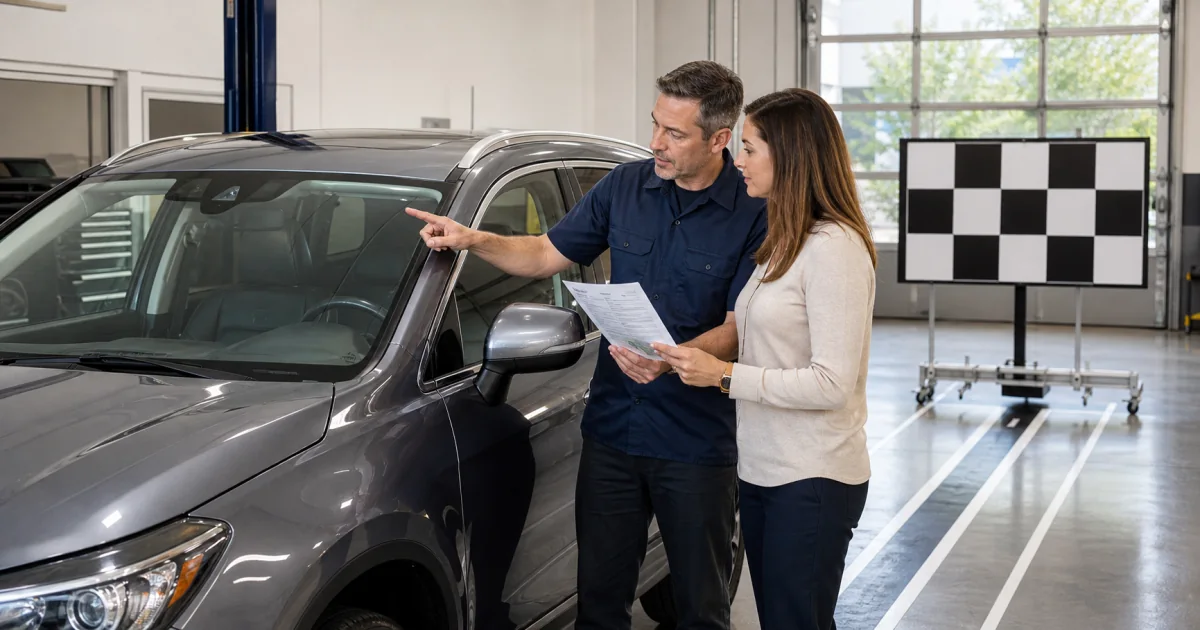
A windshield camera can watch lane markings. Radar behind a bumper can measure distance. Cameras in mirrors or body panels can support blind-spot and parking features. When repair work changes a sensor, its mounting point, or the vehicle's ride geometry, the system may need more than a parts replacement or code scan: it may need calibration.
That extra line on an estimate can be confusing because the trigger is not always obvious. A windshield replacement may disturb a camera's view; suspension or alignment work may change the angles the camera sees; collision repair may move a bracket even when the bumper cover looks normal. The useful question is not simply “Does this car have ADAS?” It is “What does the current repair procedure require for this VIN and this operation?”
Start by identifying the features and their sensors
ADAS means advanced driver assistance systems. The label covers different functions, not one master system. The National Highway Traffic Safety Administration's driver-assistance guide explains that some features warn the driver, while others can apply braking or steering assistance. Examples include forward-collision warning, automatic emergency braking, lane-departure warning, lane-keeping assistance, blind-spot warning, rear cross-traffic warning, adaptive cruise control, and parking assistance.
Features can rely on a forward camera near the mirror, radar behind a grille or bumper, ultrasonic bumper sensors, or cameras in mirrors and panels. Marketing names vary. Give the shop your VIN and ask it to identify the equipped features, relevant sensors, and exact service information used.
- Do not assume similar feature names describe identical hardware on different vehicles.
- Keep the owner's manual available; NHTSA specifically points owners back to it for feature operation and limitations.
Know the repair events that can trigger a calibration check
Calibration rules are vehicle-specific, but several repairs deserve a written check: windshield or camera replacement; sensor or bracket removal; bumper, grille, mirror, or body-panel work near hardware; structural repair; ride-height or tire-size changes; some suspension repairs or alignments; and certain module replacements.
One manufacturer example shows why a VIN-level lookup matters. A Ford ADAS component calibration job aid lists windshield or lane-camera replacement, suspension repair or alignment, tire-size changes, some collision events, and sensor or bracket removal among triggers for specific Ford systems. That is not a universal checklist for every car. It is evidence that a seemingly separate mechanical or glass operation can affect the manufacturer's calibration procedure.
- Ask which replaced, removed, adjusted, or measured part created the calibration requirement.
- Ask for the current manufacturer procedure or a repair-order note naming it.
- If the shop says calibration is unnecessary, ask it to document the procedure and condition supporting that conclusion.
Understand what calibration is—and what it is not
A diagnostic scan checks module communication and may reveal stored codes. Calibration aims a sensor or teaches its reference position using the manufacturer's process. Work may be static with measured targets, dynamic during a controlled road drive, or both. Programming, alignment, scanning, and calibration are related but not interchangeable.
A lack of warning lights does not prove that the required post-repair procedure was completed. Conversely, a warning light does not identify the root cause by itself. The estimate should name the affected system, the operation being performed, and the evidence that it completed successfully. Avoid accepting vague lines such as “reset electronics” when the manufacturer procedure calls for a defined calibration or aiming step.
Read the estimate as a repair sequence
Treat ADAS work as a sequence, not a surprise add-on. The facility may first document warnings, scan results, sensor damage, alignment, tires, ride height, and alterations. Physical repair follows. Calibration, programming, post-scan, road test, and reporting should follow the vehicle procedure.
The IIHS-HLDI analysis published August 11, 2026 explains the cost tension clearly: crash-avoidance sensors can be expensive and often require calibration after replacement, yet the systems also prevent crashes. The lesson is not to delete a legitimate calibration line to make an estimate look cheaper. It is to verify why the line exists, what it includes, and whether the resulting safety feature was returned to the required condition.
- Confirm whether calibration is performed in-house or by a named sublet provider.
- Ask whether alignment, tire pressure, fuel load, cargo, lighting, weather, road markings, or target-space conditions must meet procedure requirements.
- Ask what completion record you will receive and which warning lights or feature checks were verified before delivery.
Put the cost with the correct payer
Who may pay depends on why the work is needed and on the applicable contract or policy. For crash damage, collision insurance may apply when that coverage was purchased; comprehensive coverage may apply to causes such as glass damage, weather, theft, or vandalism, subject to the policy. The National Association of Insurance Commissioners' consumer guide explains these broad categories, but your deductible, limits, state rules, insurer estimate, and policy language control the actual claim.
A manufacturer's warranty addresses covered defects under its terms. A recall remedy addresses a safety defect identified for affected vehicles. A vehicle service contract is a separate paid agreement for specified breakdowns and benefits. The FTC's warranty and service-contract guidance tells consumers to examine who backs the contract, covered parts and services, exclusions, claim approval, maintenance duties, and repair-facility rules. Collision damage, glass breakage, maintenance, adjustments, or calibration without a covered breakdown may be outside a service contract.
- Ask the shop to separate crash or glass damage, mechanical failure, maintenance, diagnostic work, alignment, calibration, and optional work on the estimate.
- Do not authorize work on the assumption that one payer will reimburse it later; obtain required approval first.
- If two payers might be involved, ask each to identify its authorized lines and your expected balance in writing.
Verify the repair before accepting the vehicle
At pickup, compare the invoice with the approved estimate. It should identify the repaired area, affected sensors or modules, calibration type, sublet provider, result, and remaining warnings. Request alignment measurements when applicable. Save scans, calibration reports, photos, and claim authorizations.
Then review how each driver-assistance feature is supposed to behave in the owner's manual. NHTSA stresses that the driver remains responsible for steering, braking, acceleration, and monitoring even when assistance is active. Test features only in safe conditions allowed by the manual. Do not try to provoke automatic braking, lane intervention, or another emergency function on public roads.
Respond carefully if the system behaves differently
Return promptly if a warning remains, a feature is unavailable, lane guidance pulls, adaptive cruise changes, a camera view is misaligned, or parking or blind-spot alerts differ. Record the message, time, weather, road, speed, and feature status—without taking photos while driving.
Ask the facility to compare the concern with the pre-repair scan, calibration report, alignment measurements, and current manufacturer procedure. If the explanation is unclear or the vehicle still feels unsafe, pause use of the affected feature and seek a qualified second opinion. For a broader authorization record, use the seven-step repair approval checklist before additional work begins.
Keep calibration connected to the original repair record
ADAS disputes get harder when the glass invoice, body repair, alignment, calibration, and authorization live in separate files. Keep one record with the VIN, equipment list, estimates, photos, procedure reference, scans, alignment sheet, calibration result, sublet invoice, claim numbers, approvals, final invoice, and return visits.
If a mechanical breakdown led to the work, follow the vehicle service contract claim sequence before authorizing covered repairs. If the event was a crash or external damage, review how car insurance differs from mechanical-breakdown protection. Those links help keep the failure, repair operation, calibration, and responsible payer from being blurred together.
The seven-question ADAS calibration decision aid
- Features: Which driver-assistance features and sensors does this VIN actually have?
- Trigger: What removed, replaced, adjusted, damaged, or measured part caused the calibration check?
- Procedure: Which current manufacturer procedure applies to this vehicle and repair?
- Sequence: Are scan, alignment, programming, calibration, road test, and physical repair listed separately where appropriate?
- Provider: Who performs the calibration, and is any part of the work sent to a sublet facility?
- Payer: Is the cost assigned to insurance, manufacturer warranty, recall, service contract, repair warranty, or the owner—and is authorization documented?
- Proof: What final scan, calibration result, alignment sheet, invoice, and feature-status documentation will you receive?
How DriveOn fits
DriveOn is a vehicle service contract, not a manufacturer's warranty or auto-insurance policy. If a covered mechanical breakdown affects a covered component and ADAS-related diagnosis or calibration is part of an authorized repair, benefits still depend on the contract terms, exclusions, eligibility, limits, maintenance obligations, prior authorization, repair-facility requirements, and the actual claim circumstances. Crash damage, glass damage, routine maintenance, adjustments, software-only concerns, or calibration without a covered failure may not be covered. Review DriveOn coverage boundaries and the contract before work begins.
Bottom line
ADAS calibration does not belong on every modern-car invoice, but it is not optional when the current manufacturer procedure requires it. Connect the requirement to the exact repair, assign the correct payer, and leave with a documented result. If the vehicle or feature behaves differently afterward, return to the repair record.