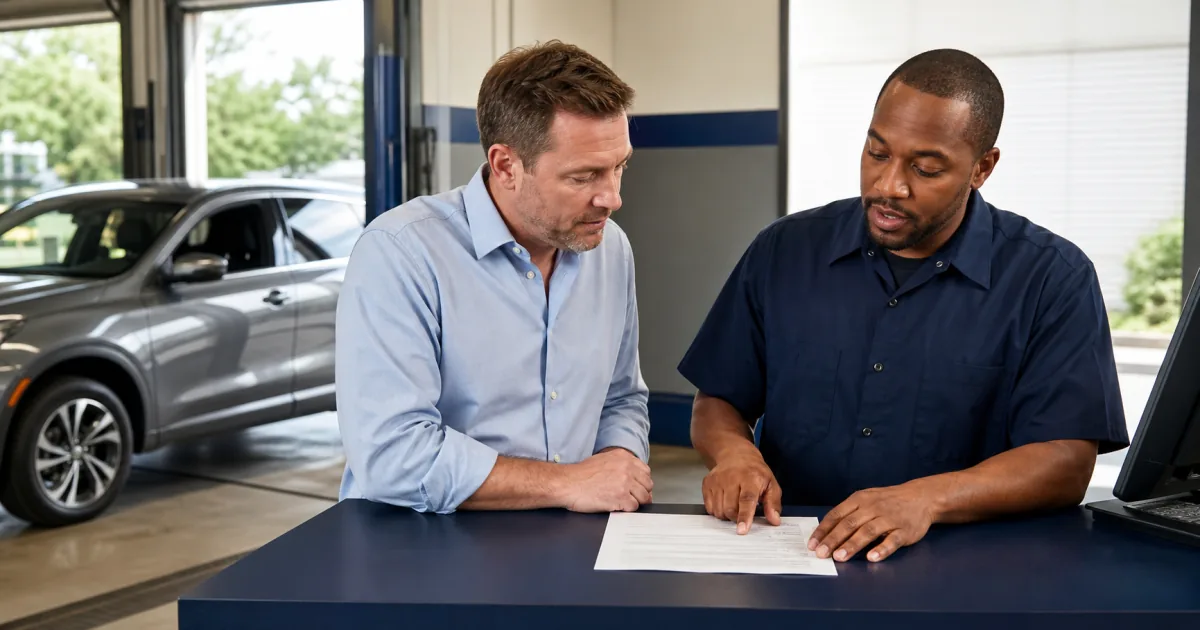
“The claim is approved” can sound like “the bill is covered.” A shop may quote one amount while a vehicle service contract authorizes less. The difference is not automatically an error or automatically yours. Every line needs a payer, contract basis, and approval.
A vehicle service contract—often marketed as an “extended warranty”—is a separately purchased agreement for specified repairs and benefits. It is not the manufacturer's warranty included with a new vehicle. The Consumer Financial Protection Bureau explains that service contracts pay some repair costs above or after manufacturer coverage, while the actual contract controls what is included and excluded.
Before authorizing work, use the six buckets below. For a total denial, start with why a car repair claim may be denied.
First, confirm which promise you are using
A manufacturer's warranty, recall, shop warranty, auto insurance, and vehicle service contract are different promises. Ask the advisor to name the payer and claim number. Manufacturer warranties address covered defects; recalls address covered safety defects; shop warranties may cover earlier work; insurance responds to covered external loss; service contracts pay described benefits.
The FTC's auto warranty and service-contract guide draws the central line: a manufacturer's warranty comes with the vehicle, while an optional service contract is bought separately. The FTC also tells consumers to ask whether a contract pays the mechanic's actual labor cost, how much it pays for parts, whether depreciation applies, what replacement parts it allows, and whether prior approval is required. Those questions are the core of a partial-payment review.
- Get the claim number, obligor or administrator, contract section, and authorization in writing.
- Ask whether a manufacturer warranty, recall, shop warranty, insurance, or goodwill program was checked.
- Do not let the shorthand “warranty” blur which written agreement is responsible.
Put the estimate and authorization side by side
Request the shop's itemized estimate and the administrator's itemized authorization. Match each operation, then record the shop amount, authorized amount, difference, explanation, and expected payer.
The FTC's Auto Repair Basics says a written estimate should identify the condition, parts, and anticipated labor, and a completed repair order should list each repair, parts, labor charges, and odometer readings. That detail lets you separate a coverage gap from a price disagreement or newly recommended work.
- Match diagnosis, teardown, repair labor, parts, fluids, seals, programming, calibration, shop supplies, taxes, towing, and rental separately where applicable.
- Mark each line covered, not covered, pending, or not submitted—never just “short paid.”
- Ask the shop not to combine authorized and owner-pay work into one vague package.
Bucket one: reconcile the labor rate and labor time
A repair facility can charge an hourly rate that differs from the contract's payable rate. It can also estimate a different number of hours than the administrator allows under a referenced labor guide or procedure. Rate and time are separate variables: a $20 hourly difference across six hours is not the same dispute as the shop billing eight hours while the authorization allows six.
Ask both parties for the rate, hours, and source. The shop should identify flat-rate time, diagnosis, or added work; the administrator should identify the contract term and labor-time source. Neither number is universal.
- Shop labor rate and estimated hours
- Authorized labor rate and allowed hours
- Named labor guide, manufacturer procedure, or documented extra operation
- Who pays any rate or time difference if the shop will not accept the allowance
Bucket two: identify the allowed part and price
The shop may quote a new OEM part while the contract permits aftermarket, remanufactured, rebuilt, recycled, or equivalent parts. The administrator may source a different price, apply contract-allowed depreciation, or state a payment limit. Price alone does not make parts comparable.
Record part number, condition, source, warranty, shipping time, and hardware. Ask whether the shop's preferred part creates only an owner-paid price difference or changes the claim. Review how aftermarket parts affect warranties and service contracts before treating “OEM” and “covered” as synonyms.
- Part identity and condition: new OEM, new aftermarket, remanufactured, rebuilt, or recycled
- Authorized part price, shop part price, freight, core charge, and return terms
- Parts warranty and whether repeat labor is included
- Availability and whether the repair facility will install an administrator-sourced part
Bucket three: separate diagnosis from the repair
Diagnosis can establish a covered failure without making every step payable. Scan time, testing, teardown, reassembly, inspection, and sublet diagnosis may have separate rules. A contract may apply an allowance or leave some work to the owner.
Ask what diagnostic work was authorized before it occurred, what finding it produced, and which portion appears in the repair benefit. For engine or transmission disassembly, use the diagnostic and teardown fee checklist before approving open-ended work. Prior authorization matters because evidence can disappear once parts are removed or discarded.
- Initial scan or inspection
- Pinpoint testing and technician time
- Teardown, inspection, reassembly, and fluid replacement
- Third-party inspection, programming, calibration, or sublet work
Bucket four: find excluded or unrelated operations
An estimate often contains more than the failed component: maintenance, wear, external or pre-existing damage, corrosion, contamination, modifications, supplies, upgrades, or unrelated work. Seals, fluids, fasteners, taxes, fees, alignment, and calibration still need an assigned payer.
Ask the administrator to cite the contract term for every excluded line and the shop to explain why that operation is required. “Not covered” and “not necessary” are different findings. You may still need a safe repair even when a contract does not pay for it. Review coverage boundaries and common exclusions and get a separate owner-pay authorization before that work begins.
- Required to complete the covered repair but excluded by the contract
- Recommended maintenance or preventive work
- Damage caused by an external event or a non-covered condition
- Optional upgrade, convenience item, or unrelated repair
Bucket five: apply deductibles, limits, and prior payments
A deductible may apply per visit, repair, or another contract definition. A sublimit, labor cap, aggregate limit, market-value provision, or prior payment can also reduce benefits. Calculate these after identifying covered work.
Ask for the starting limit, prior payments counted against it, this authorization, deductible, and remaining limit. The California Department of Insurance vehicle service contract guide emphasizes reading the whole agreement, identifying the obligor, and following the claim and dispute provisions. Your state and contract may use different rules, so treat a regulator's guide as a starting point rather than a decision on your claim.
- Deductible definition and number of deductibles
- Per-repair or per-component sublimit
- Aggregate limit and prior claims counted
- Any market-value, depreciation, or betterment provision actually cited in the contract
Bucket six: lock the owner balance before work starts
After reconciling five buckets, ask for a revised page showing contract benefit, other payer amounts, deductible, owner-pay lines, fees, and maximum balance. Confirm what happens if inspection finds more damage or a part is unavailable.
Follow the seven-step repair authorization checklist and the vehicle service contract claim sequence. Do not sign an open-ended authorization because someone expects the difference to be resolved later. If the shop begins work beyond the approved amount, state repair laws may affect notice and consent; for example, Florida's consumer repair guidance describes estimate, authorization, guarantee, and storage-fee rules, but requirements vary by state.
- Maximum owner amount authorized now
- Dollar or percentage threshold requiring new approval
- Who can approve supplements and how they will be documented
- Pickup, storage, rental, towing, and parts-delay responsibilities
Escalate a mismatch with documents, not labels
If the balance still looks wrong, send the administrator the declarations, relevant contract sections, estimate, diagnosis, authorization, and one-page reconciliation. Identify contested lines, requested resolution, and ask for a written provision-based response.
Ask whether the shop will accept the authorized rate or part, revise an unsupported operation, or pause new charges during review. If internal review fails, use the contract's complaint route and the regulator for the obligor in your state. The FTC advises contacting the dealer and service-contract company first, then a state attorney general or the FTC when appropriate.
- One claim number and one current estimate version
- A line-by-line dollar difference rather than a complaint about the total alone
- The contract page supporting your position and the page cited by the administrator
- A specific request: revised authorization, explanation, second inspection, appeal, or safe release of the vehicle
The six-bucket partial-payment worksheet
- Promise: Name the payer—manufacturer warranty, recall, shop warranty, insurance, or vehicle service contract—and record the claim number.
- Documents: Place the itemized shop estimate beside the itemized authorization; use the same operation names and current versions.
- Labor: Record shop rate × hours, authorized rate × hours, the time source, and who is expected to absorb any difference.
- Parts: Match part number, condition, source, warranty, freight, core charge, availability, and authorized price.
- Diagnosis: Separate scans, testing, teardown, inspection, reassembly, programming, calibration, and sublet work.
- Exclusions: Assign maintenance, wear, external damage, upgrades, fluids, seals, supplies, taxes, and unrelated operations individually.
- Limits: Show deductible, sublimits, aggregate limit, prior paid claims, depreciation, and any cited market-value provision.
- Authorization: Write the maximum owner balance, supplement threshold, pickup deadline, storage terms, and required prior-approval method.
- Dispute: Send the contested lines, documents, contract provisions, and requested resolution in one dated record before work changes the evidence.
How DriveOn fits
DriveOn is a vehicle service contract, not a manufacturer's warranty, recall, repair-shop guarantee, or auto-insurance policy. A DriveOn claim payment depends on the selected contract terms, covered failure, exclusions, eligibility, limits, maintenance obligations, diagnosis, repair-facility requirements, prior authorization, available benefits, and actual claim circumstances. An approved component does not mean every estimate line is covered. Review the written authorization and DriveOn claims process before work begins.
Bottom line
An approved claim is a starting point, not a substitute for an itemized payment decision. Match the shop's estimate to the authorization across labor, parts, diagnosis, exclusions, deductibles, and limits. Approve only the work and owner balance you understand, preserve the evidence, and put every supplement through the contract's authorization process.